Friday’s Forgotten Book: The Etruscan Net by Michael Gilbert

The Etruscan Net by Michael Gilbert (Hodder & Stoughton, 1960), later released as The Family Tomb, is one of Gilbert’s stand-alone mysteries. There actually isn’t much mystery to it but there are some great characters to help the obvious plot unfold. Robert Broke has taken refuge in Florence, after the death of his wife and child in an auto accident. He runs a high-end bookstore and largely stays to himself, despite the attempts of the expatriate community to involve him in their social gatherings.

He breaks this habit to attend a party at the villa of Professor Bruno Bronzini, an eccentric who is sponsoring the excavation of an Etruscan burial site on his property and who is a known dealer in Etruscan antiquities. Broke is something of an authority himself on some aspects of the Etruscans, and the professor invites him to visit the excavation site, where he sees a number of gold and alabaster artifacts that he asks a few questions about but doesn’t get satisfactory answers.

A few days later the elderly craftsman whose daughter helps run the bookstore asks to talk to Robert but never gets past idle chitchat as he is convinced someone is listening to their conversation. Soon after the elderly gentleman is found dead in the street, clearly the victim of a hit and run, and Robert’s car has damage in all of the right places so he is arrested without much evidence. Neither Robert nor the daughter have learned what the victim was worried about and they both assume it had something to do with his death, but the police are not interested. Robert’s friends flock to his defense while Robert sits in his cell reading. The real question of the book is how they will get him out of jail.

The book is full of well-drawn characters. The offbeat professor, the doyenne of the Florence expatriates, Robert’s imperious sister who arrives to help him, the sneaky boarder who rents a room from the elderly craftsman, the craftsman’s wife. Even the two mystery men whom everyone assumes are from Sicily are clearly outlined. I was disappointed in the minimal plot but still found the story a worthwhile read.
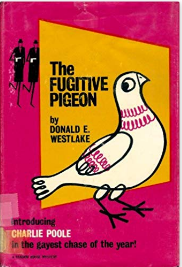
Friday’s Forgotten Book: The Fugitive Pigeon by Donald Westlake

The Fugitive Pigeon by Donald Westlake (Random House, 1965) is one of the MWA Grand Master’s comic mysteries. I’ve read Westlake’s Parker books, written under the name Richard Stark, and loved them, but never got around to his capers, of which there are many. This story is one of the early ones.

Charlie Poole is a bum and knows it. His father vanished early in his life and his mother worked hard to raise Charlie, but Charlie has not shown the slightest interest in accepting adult responsibilities at age 24. After not being able to hold a job for more than two or three months, his uncle by marriage gives him a job running a bar in Canarsie in remote Brooklyn. The bar steadily loses money and Charlie worries about it but his Mob-connected uncle explains that it is supposed to lose money, only Charlie never quite understands the logic behind it all. Once in awhile Charlie accepts a package from a courier and then turns it over to someone with the proper code words but other than that Charlie leads a quiet life, providing drinks as requested and watching television, then going upstairs to the nice small apartment that is provided as part of the job.

Until one night when a couple of serious-looking men enter the bar at closing time and attempt to kill Charlie. Charlie escapes and runs to his uncle, who refuses to talk to him, telling him the uncle doesn’t know what Charlie has done to antagonize the Mob but the uncle can’t afford to get involved. Charlie is convinced that if he can get to the man who ordered his demise that he can explain that he hasn’t done whatever it is they think he’s done.

Charlie evades the goons again by the thinnest of hairs to find Artie Dexter, the only friend he can think of who might be awake at 4:00 in the morning; fortunately Artie is holding an all-night party. Once everyone gets some sleep, Artie is prepared to drive Charlie to visit Mr. Big on Long Island to explain his innocence. Charlie and Artie arrive at the palatial estate to find Mr. Big recently murdered and everyone believing Charlie is the culprit. Artie and Charlie once again bolt by a miracle, this time taking Mr. Big’s daughter as hostage.

The ensuing car chases all over New York are fun, and his meeting with Mr. Big’s boss, an avid bridge player who resents the interruption of his weekly card game, is a hoot. As usual, Westlake can’t put a foot wrong. A great quick read.

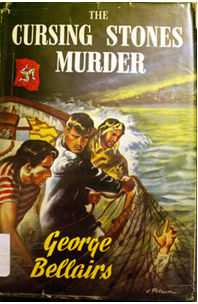
Friday’s Forgotten Book: The Cursing Stones Murder by George Bellairs

I continued my investigation into the works of George Bellairs and his detective Chief Inspector Littlejohn by reading The Cursing Stones Murder (Gifford, 1954), the book immediately following the one I reviewed a few weeks ago, and found it more to my liking, as it is more of a classic police procedural.

While scallop dredging off the coast of the Isle of Man, a boat drags up the body of a well-known philanderer along with its catch. The philanderer was believed to be in Europe, hence no one noticed his disappearance a month or more earlier. Inspector Sid Perrick fastens his suspicions on Johnny Corteen, the brother of one of the many women who had been wronged by the victim. While Corteen can’t produce an alibi for the estimated time of death, no one thinks he is capable of killing someone in cold blood either. The area church leader Archdeacon Kinrade invites Chief Inspector Littlejohn on a long overdue visit to informally investigate the crime. He does not want to cross the local police by officially requesting the assistance of Scotland Yard but thinks Littlejohn can quietly poke around a bit and get Corteen out of jail, thereby helping Corteen’s long-suffering mother.

Littlejohn has a lot to work with, the victim had antagonized anyone with an attractive wife or daughter, as well as the wives and daughters themselves. In this particular story, his investigation sidekick is the Archdeacon rather than Inspector Cromwell, his usual partner, although Cromwell shows up late in the story. In addition, Inspector Perrick is a little sensitive about Littlejohn working on his case, but recognizes Littlejohn’s seniority and position, and insists on conferring with him daily to learn what Littlejohn has found out and his suggestions for further research.

Littlejohn brought his wife and the family dog with him on this trip and they add interest and depth to what would otherwise be a straightforward police investigation. Bellairs describes the Isle of Man, where Bellairs himself relocated, as an exquisitely beautiful place, although the dangers men who make their living from the sea are also fully and terribly portrayed, with a September gale wreaking havoc at the end of the book. I am quite impressed with Inspector Littlejohn and I can see I need to keep reading the series. For fans of British detective procedurals.

Friday’s Forgotten Book: The Cat Screams by Todd Downing

Todd Downing (1902-1974) published nine detective novels between 1933 and 1941 before abruptly abandoning writing altogether. Most of his books were set in Mexico; his series detective is U. S. Customs Agent Hugh Rennert. See more about Downing on the Golden Age of Detection Wiki, http://gadetection.pbworks.com. See also Clues and Corpses: The Detective Fiction and Mystery Criticism of Todd Downing by Curtis Evans, preface by Bill Pronzini (Coachwhip Publications, 2013).

His second book The Cat Screams (Doubleday, 1934) was hailed by his publisher as a major literary occasion and it was featured as a Crime Club Book of the Month, unusual for a relatively unknown author.

Agent Hugh Rennert is on vacation, traveling via train to a resort in Mexico. He notices a young man on the train with him, who turns out to be the only son of a wealthy oil man on his way to the same resort to find an actress that he is determined to marry. His conservative father does not want an actress in the family, yet the son plans to marry her anyway. They stay at the same hotel, where the owner has a Siamese cat in heat that yowls at all hours. Other residents include the actress, a blackmailer, and a private detective sent by the conservative father to investigate the actress. It is not a happy group, even less so when one of the staff is suspected of having smallpox and the entire building is quarantined.

Almost immediately after Rennert’s arrival the deaths of visiting North Americans begin. The local police are anxious to write them off as suicides so as not to jeopardize the tourist revenue so important to the town but Rennert has his well-founded doubts. Rennert takes advantage of the police chief’s lack of English to interrogate the various hotel residents, who in my opinion were far more patient with what could be considered his interference than I would have been.

I did not find this story a scintillating read. I put it down about a third through and waited a couple of weeks to see if that would help. It didn’t. The plot moved slowly in places and rushed in others, and I thought some of the story was a little too fantastic. I am happy to have made Downing’s acquaintance, however I am not in a hurry to delve further into his works.

One final note: those people smoked a lot. A LOT! I wanted to cough just reading about everyone lighting one cigarette from the end of another. I understand that was typical of the time and place but things have certainly changed.

Friday’s Forgotten Book: I Start Counting by Audrey Erskine Lindop

Audrey Erskine Lindop (26 December 1920 – 7 November 1986) wrote about eight novels, lists of her works vary. I Start Counting (Doubleday, 1966) seems to have been the most well-known of them, based on the success of the film adaptation with Jenny Agutter in her first starring role. It won the Grand Prix de Littérature Policière – International Category in 1967.

The story is narrated by Wynne Kinch, an orphaned 14-year-old in the suburban Midlands, during the free-wheeling 1960s of sex, drugs, and rock and roll. Wynne is part of a blended family, living with her paternal grandfather, her aunt by marriage Lucy, and Lucy’s three children. The twins Nellie and Len are Wynne’s cousins from Lucy’s second marriage. George, Lucy’s older son from her first marriage, is no relation at all. But they are a true family, squabbling internally and coalescing at the slightest hint of external threat. Wynne has developed a walloping girlish crush on George, and he’s doing his best to wait for it to run its course.

In addition to the general angst of a self-conscious teenage girl with an embarrassing family and excess baby fat, Wynne is sad because the family recently moved to a high-rise apartment when the neighborhood where she’d lived most of her life was slated for reconstruction. She makes frequent trips to visit the old house, unbeknownst to the rest of her family, who would be horrified, as a serial killer is on the loose. So far responsible for the deaths of four girls, the strangler has given the police few clues to work with. But self-absorbed Wynne does not think twice about disappearing alone to visit the old house, with no one knowing where she is.

Wynne gradually decides for not very good reasons that George is the strangler and that she must protect him at all costs. Her bumbling eventually brings George to the attention of the police, and Wynne herself is charged with accessory to murder after the fact.

Apparently readers either love or hate this book, there seems to be no middle ground. I loved it when I first found it as a teenager years ago. I completely identified with Wynne and her inability to fit inside her skin. I found (and still find) the extended family hilarious. Of course Granddad raises mice. Keeping pigeons would be far too ordinary. The offhand mentions of mice breed shows and mice industry newsletters still evoke snickers. I identified strongly with the domestic chaos resulting from six adults sharing living space, as at the time my family of eight was wedged into a house far too small for it. Although some reviewers consider the characters poorly drawn, I can only assume they were reading a different book.

The mystery is generally not prominent, it simmers on the sidelines most of the time and seems to be a catalyst to the characters and their interactions with each other, which I consider a fascinating way to construct a suspense novel. My reaction to the identity of the strangler was first to be startled and then to ask myself how I missed it. Definitely a fair-play mystery. All in all, I still love this book.

Friday’s Forgotten Book: The Emperor’s Snuffbox by John Dickson Carr

The Emperor’s Snuffbox by John Dickson Carr (Harper, 1942) is a dazzling display of plotting pyrotechnics. No locked room but a puzzle so tightly woven I had to read the explication twice before I fully understood all of the moving parts.

Eve Neill has finally convinced her cheating husband Ned Atwood to cooperate in a divorce. In conservative France where they are living in a resort area, there is every incentive for a woman to remain in a marriage but Eve has had it with Ned. She doesn’t even care about the potential for embarrassing publicity, she just wants him out of her life. Since they were married in France and the divorce action completed in France, there was little mention in the English papers to her great relief. After a few months Eve is bored and lonely and a little depressed when the stuffed shirt son Toby Lawes of the English expatriate family across the street begins to court her. His family kindly expresses happiness when she accepts his proposal of marriage, although her status as a divorcee shocks them a little.

The murder of the family patriarch, Sir Maurice Lawes, late one night, changes everything. Sitting up late admiring a new and expensive acquisition for his collection of tchotchkes, Sir Maurice is brutally and fatally attacked with a poker. The French police zero in on Eve, whose clothing has unexplained blood and who has no alibi. She also has no motive but that does not bother them. The French inspector calls in Dr. Dermot Kinross, an eminent English criminal psychologist who often works with the police, because he does not believe Eve is guilty. Dr. Kinross also decides Eve is not guilty and begins looking hard at the family of the victim, who after all were in the house at the time and had the easiest access. From that point on one startling plot twist after another unfolds.

All of the clues are available in this fair play mystery and I missed about half of them. Highly recommended for Golden Age fans.

Friday’s Forgotten Book: She Came Back by Patricia Wentworth

She Came Back by Patricia Wentworth (J.B. Lippincott, 1945) is the ninth mystery featuring Miss Silver, former governess and now modestly successful private investigator. The family of Lady Anne Jocelyn is stunned when Anne appears unexpectedly in her country home, more than three years after she was believed killed by Germans while she, her husband, a cousin, and others were making a desperate bid to escape France just after the invasion. Anne and the cousin had a strong family resemblance. Anne contends that the cousin was mistaken for her in the dark and now lies buried in the churchyard under Anne’s name.

Sir Philip Jocelyn was on the verge of marrying someone else and he is reluctant to welcome his wife home. He agrees to her request for six months to try to re-establish their marriage but he is not convinced that he should. Their relationship had been shaky before Anne’s supposed death and he does not expect their differences to be easily resolved. Complicating all of this is the fact the money in the marriage belongs to Anne, not Philip. Unless she remains dead, he is more or less her pensioner. Then a former nanny of the dead cousin turns up dead herself, on a road no one expected her to be on and Scotland Yard is called in. In no time at all Sergeant Frank Abbott is consulting Miss Silver.

This is the third Miss Silver mystery I’ve read in which someone who is thought to be dead appears again, very much alive. The other two are The Case of William Smith and Miss Silver Deals with Death. All three are set during the confusion and upheaval of World War II, when communications, such as they were, were disrupted and people could disappear easily if they wanted to, and sometimes even if they didn’t want to. It’s hard to imagine doing that now, with DNA kits being sold by mail and international databases of fingerprints easily accessible to any law enforcement representative. These books are especially intriguing to me, as they clearly delineate a very different time and place that actually wasn’t that long ago. For fans of traditional mysteries and of mysteries set during World War II.

Friday’s Forgotten Book: Corpses in Enderby by George Bellairs

George Bellairs is a byword in the world of classic British crime fiction. The pseudonym of Harold Blundell (1902-1982), a Manchester bank manager as well as a freelance journalist, he published 57 popular classic police procedural mysteries featuring Inspector Thomas Littlejohn of Scotland Yard between 1941 and 1980. Corpses in Enderby (John Gifford, 1954) is 22nd in the series.

The small town of Enderby is stunned when Ned Bunn, a prosperous and unpleasant merchant, is shot in front of his store one night. He’d just thrown his assistant out for courting Bunn’s 40-year-old daughter, after gleefully announcing his intent to foreclose on the mortgage he held on the store next door. Since the assistant was the only one known to be nearby, the local police investigator rushes to pin the crime on him. His superior the Chief Constable of the county is not so sure and calls in Scotland Yard for a second look.

Inspector Littlejohn and Sergeant Cromwell arrive in Enderby as the large and decidedly peculiar Bunn family gathers to attend the funeral and more importantly to learn how the decedent’s considerable assets were to be distributed. As Littlejohn soon learns, a trust established by the previous generation was dissolved with Ned Bunn’s death, and as a result several individuals in the family will inherit thousands of pounds.

This strong motive for murder leads Littlejohn to look closely at the whereabouts of family members at the time of the shooting. Interviewing most of them is painful, as they are more than a little eccentric, and most of them cheerfully dissemble without a qualm. Bellairs created a set of comical characters in the Bunns who are entertaining in their horridness.

But the Bunns aren’t the only ones in the story who are so awful they are funny. The landlord of the inn where Littlejohn and Cromwell are staying and his wife treat the policemen to a long-running domestic drama that unexpectedly resolves itself just as Littlejohn hones in on the culprit and could do without the distraction.

The characters and their antics tend to usurp the investigation in this story and downplay the iniquity of the crimes. I plan to read a few more in this series to see if this is a pattern. Fortunately many of them have been released in ebook format and are more readily available than they would have been 10 years ago. For devotees of classic crime fiction.

Friday’s Forgotten Book: Through the Wall by Patricia Wentworth

Through the Wall by Patricia Wentworth (Lippincott, 1950) is the 17th (according to www.stopyourekillingme.com and Wikipedia) or 19th (Amazon and GoodReads) mystery featuring Miss Maud Silver, former governess and current successful private investigator. While each book references her former profession, I have yet to find the book, if one exists, that explains exactly how she made that transition. It would be a story well worth reading.

In this outing Martin Brand takes his revenge on the relatives that have lived off his generosity for years by leaving his substantial estate to an unknown niece. Marion Brand has been working in a real estate office, quietly supporting herself and a sickly sister, along with the sister’s layabout husband, and had no notion that she had a wealthy relative until a solicitor contacts her.

She is stunned to learn about her inheritance. While she comes to terms with just how considerably her circumstances have changed, the layabout husband makes plans for the expenditure of the fortune she’s inherited, confident that Marion will divide the money with her sister. The enraged relatives are left without the proverbial shilling, including a home. Marion has also inherited Uncle Martin’s house near the sea, which is actually two homes with connecting doors. He advises her in his will to re-establish the division between the two houses, as evicting the relatives will cause more trouble than she is likely prepared for.

While living next door to antagonistic people will be awkward, Marion loses no time in packing up and moving into her half of the house, where she hopes her sister will grow stronger. One of the people in the other half of the house when she arrives is a visiting actress and singer who is being blackmailed. She consults Miss Silver but declines to take her advice to go to the police. When the actress is found murdered a few days later, wearing Marion’s coat, the police ask themselves if the actress was killed because of something in her life or if she was killed because her murderer thought she was Marion Brand?

Fortunately Miss Silver and her favorite Scotland Yard detectives are on the case. I usually have some idea of the culprit in these books but this story had several unpleasant people and I would have been happy to see any of them led away in handcuffs. This series is my current comfort read. I have read and re-read Agatha Christie’s novels so often that I can quote from my favorites, so there is little point in visiting them yet again. This title filled the need for an enjoyable way to spend a few hours. Recommended for fans of Golden Age detection.

Friday’s Forgotten Book: Hunt with the Hounds by Mignon G. Eberhart

Mignon G. Eberhart, 1899-1996, was a prolific author of mysteries and romantic suspense. Her long career began in 1929 with a mystery featuring Sara/Sally Keate, a nurse in New York, who was Eberhart’s only series character. Keate featured in seven books. The rest of Eberhart’s prodigious output consisted of 53 stand-alone novels and several collections of short stories. She received the Grand Master Award from Mystery Writers of America in 1971.

Hunt with the Hounds (Random House, 1950) was released about midway in Eberhart’s publishing career. This nice locked-room mystery is set in the small town of Bedford in central Virginia, in fox hunting country. It opens with the acquittal of Jed Bailey, who has been on trial for the murder of his wife Ernestine. The eyewitness testimony of Sue Poore, who said she saw Jed sitting in his car while she was at the front door of the house ringing the doorbell when the fatal shots were fired inside, was key to his exoneration. Jed had been openly pursuing Sue despite his married state, to the dismay of everyone around him including Sue. Since Sue and Jed were the only people known to be in the vicinity at the time Ernestine was killed, after the trial the police focus their attention on proving her to be the killer. Sue is utterly taken aback and her family and friends, including the local police chief who has known Sue all her life, do their best to show the state police captain he is mistaken.

The action unfolds against the backdrop of fox hunting, which is taken very seriously by the area residents, who ride to hounds nearly every day during the season. A fair amount of detail about fox hunting is included but not as much as is found in the Sister Jane Arnold mysteries by Rita Mae Brown. Mostly what becomes apparent is the long-buried resentments and rivalries of people who grew up together in an area where social status is a major consideration, so people hold on to it by any means at all. Eberhart cleverly diverts suspicion in first one direction, then another, until the final revelation in the last chapter. Of interest to mystery readers who value careful plots and characterization and small town settings.