Friday’s Forgotten Book: The Dogs of War by Frederick Forsyth

The Dogs of War by Frederick Forsyth (Viking, 1974) is the third of 18 thrillers from this reliable author of political intrigue and quite possibly my favorite. It is easy to forget about Forsyth’s earlier books because his stories are always set in the present or the immediate future. Re-visiting them after several years forces the reader to recall long-gone political crises, which have generally faded in the light of new calamities.

“Cat” Shannon was a mercenary fresh out of the Angolan war of independence. He was at loose ends in London when mining magnate Sir James Manson approached him and wanted to hire him to overthrow the government of a small African country. The task intrigued him, as well as the open-ended budget; just what Manson intended to do with the little third-world backwater also interested Shannon greatly, and Manson wasn’t saying.

While Shannon sent word to his friends that he had work for them and developed a comprehensive plan for a coup, he also did a little research on Sir James. He learned that Manson had a mining report from the small country of interest, showing significant deposits of valuable minerals. He also learned that the final report to the current ruler of the country had been altered to reduce the size of the deposits and increase the estimated difficulty of extraction. It was obvious Sir James intended to exploit the backwards nation for his own benefit. This plan didn’t sit right with Shannon, who, despite being a mercenary, had his own set of personal ethics. Thus one of the most satisfying stories of double-dealing I have ever seen begins.

While there are shootouts and bloodbaths aplenty, what entertained me the most in later re-readings of this book is the detailed planning of the takeover. I doubt that Cat Shannon or Frederick Forsyth are aware of the Project Management Institute or its purpose, but their plan could have come from a senior fellow of PMI. Cat identified the goal, the actions necessary to reach the goal, a timeline to complete them, the critical path, dependencies, risks with mitigations, and personnel assignments, in short, a classic project plan. It isn’t often that my world of mystery reading intersects with my world of program management, hence my fascination.

Forsyth, who received CWA’s Diamond Dagger Award in 2012, announced his retirement in 2016 and then released another thriller in 2018. It is not clear if another is in the works or if he really will stop writing fiction. In either case, his earlier books are imminently re-readable almost indefinitely.
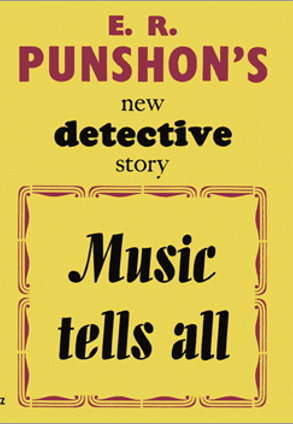
Friday’s Forgotten Book: Music Tells All by E. R. Punshon

One of my great finds last year was the prolific Golden Age author Ernest Robertson Punshon (1872-1956). Writing as E. R. Punshon, he released 35 books featuring Bobby Owen, an Oxford-educated policeman who worked his way up through the Scotland Yard ranks. He wrote another five featuring Sergeant Bell, a plodding, lugubrious London detective who nevertheless always managed to resolve his cases. Still another 20 books were stand-alone mysteries.  Dorothy L. Sayers regarded Punshon’s work highly, saying that “all his books have that elusive something which makes them count as literature, so that we do not gulp them furiously down to get to the murderer lurking at the bottom, but roll them slowly and deliciously upon the tongue like old wine.” While I don’t like them quite that much, I enjoy reading Punshon, sometimes more for his portrayal of England during the first half of the 20th century than for his plots, which are not always as solid as one could hope, although some reviewers compare him to John Dickson Carr.

In Music Tells All, published by Victor Gollancz in 1948, Bobby Owen in his 24th outing and Sergeant Bell, promoted now to Inspector, team up on a case that moves back and forth between a rural village and London. The story starts with Bobby and his wife Olive searching for a place to live. She responds to an advertisement for a home at a comfortable distance from his job at Scotland Yard. Expecting a crowd of competing seekers, they rush out only to find a quiet village with a house that seems perfect. The landlord names a rental fee far less than they expected in this time of extreme scarcity and they jump to sign the lease. They soon learn that an odd neighbor is given to playing her piano tempestuously at all hours. Everyone in the village gives Miss Bellamy a wide berth, except for their landlord who seems to be simultaneously fascinated and repulsed.

Bobby is distracted by a jewelry heist in London which involves a wild car chase through the city streets. One of the rings from the robbery is found in the village where Bobby just moved and the body of a stranger shows up in a nearby dismantled bomb shelter, bringing in Inspector Bell. The obvious suspect is a chauffeur who disappeared about the same time but several of the neighbors warrant closer inspection. Bobby doesn’t understand how his new village is tied to the robbery but can see that it is. Poor Olive is constantly searching for food for the two of them.

There aren’t enough clues to suggest the actual culprit and the motivation behind the crimes so the ending requires too much explanation, but all in all this is a good story, describing as it does life in post-war England and the citizenry determined to make do and get by.

An earlier version of this review appeared on Kevin’s Corner, https://kevintipplescorner.blogspot.com/2017/08/aubrey-hamilton-reviews-music-tells-all.html, on 21 August 2017.

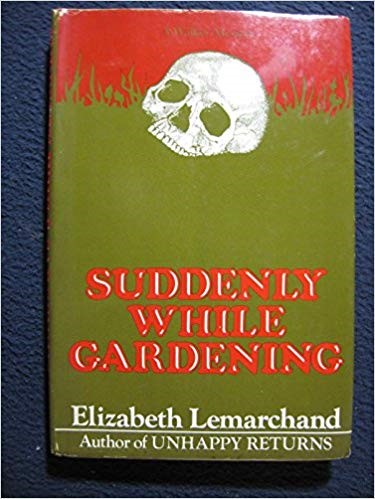
Friday’s Forgotten Book: Suddenly While Gardening by Elizabeth Lemarchand

Suddenly While Gardening (Walker, 1978) by Elizabeth Lemarchand (1906-2000) is the 10th mystery featuring  Detective-Chief Superintendent Tom Pollard of New Scotland Yard and his partner Detective Inspector Toye. On a well-deserved vacation to a rural village where his aunt lives, Pollard is happily soaking in local color in the form of a restored path used for religious pilgrimages centuries ago. He happens upon a walking group who have found a newish skeleton on the path. He has no choice but to take charge until the local authorities arrive. When they throw up their hands and call in Scotland Yard, of course Pollard is selected to investigate since he already knows the area and its people and was first on the crime scene.

One of the village residents objected strenuously to the re-establishment of the path, as it runs near his property. He is eccentric and offensive enough to draw attention to himself as a likely perpetrator until his absence from the area during the critical timeframe was firmly determined. Then an anonymous caller reports the car of a well-known young architect was seen near the site. Pollard patiently sifts through reports and interviews and about two-thirds through the story links the death he’s investigating to an earlier death that was believed to be accidental, which rearranges the supposed motive for the killing and the list of suspects entirely.

This is a pleasant classic police procedural set in an historically interesting area of England. What I was beginning to consider an unremarkable tale turned grim late in the book and I was riveted for the remainder of the story.

Elizabeth Lemarchand released 17 Pollard and Toye police procedurals between 1967 and 1988. These books are recommended for lovers of Catherine Aird’s Calleshire Chronicles and Dorothy Simpson’s Inspector Luke Thanet mysteries.

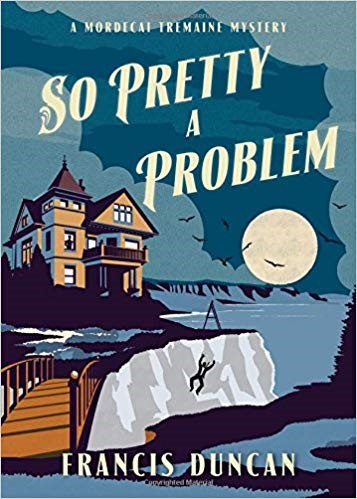
Friday’s Forgotten Book: So Pretty a Problem by Francis Duncan

So Pretty a Problem by Francis Duncan (John Long, 1947) is one of the Mordecai Tremaine mysteries, either the third (Amazon) or the fifth (Stop, You’re Killing Me). Tremaine is a retired tobacconist whose choice of leisure reading is romance stories and whose hobby is criminology. He’s on vacation in Cornwall with his friend Chief Inspector Jonathan Boyce of Scotland Yard, where he encounters the famous and controversial artist Adrian Carthallow with his wife Helen. Tremaine had met the pair briefly earlier and slipped into a chatty renewed acquaintance with them and their circle easily enough.

The Carthallows live in a fantastic home built on a piece of land that broke away from the rest of Cornwall years ago. On the ocean-facing side is a steep cliff and on the land side is a bridge that’s highly visible. So when Adrian Carthallow turns up dead of a gunshot wound and Helen insists first it was an accident and then self-defense, the local inspector is at a loss to do anything but arrest her, as neither of her stories is consistent with the physical evidence, and no one else was seen to enter the house. Yet he does not think she is guilty of murder, so Tremaine undertakes his own investigation.

The book is set up in three chronological parts: the first is the time immediately before and after the death, the second describes the relationships of the main characters and the events of the several weeks before the shooting, and the third the detailed investigation and identification of the culprit. I found the second section a bit of a slog. I read Murder for Christmas about 18 months ago and don’t remember being bored with it but I was definitely bored with parts of this book. It could easily have been reduced by 50 pages without affecting the story line or characterization or backstory.

While the plot was clever, the setting exquisite, and the characters fresh, I find I am not quite as enthusiastic about tackling a third one in the series as I was when I started this volume. Cover art from 2018 Sourcebooks reprint.

Friday’s Forgotten Book: Henrietta Who? by Catherine Aird

Henrietta Who? by Catherine Aird (Macdonald, 1968) is the second book in the Calleshire Chronicles, featuring Inspector C.D. Sloan and his inept assistant DC Crosby. Calleshire is an imaginary county somewhere in England, quite large enough apparently to support two football teams, the East Calleshires and the West Calleshires.

Early one morning Mrs. Grace Jenkins is discovered dead in the road leading to her small house on the outskirts of the village of Larking. Her only known relative is her daughter Henrietta studying at a university an hour away. What was originally supposed to be a vehicular hit-and-run is exposed as deliberate murder by the post-mortem. This examination also revealed she had never had a child, throwing Henrietta into a state of utter confusion.

She subsequently finds that the lock to the desk where her mother kept her papers was broken, and her birth certificate and her mother’s wedding certificate are missing. Because the house was locked at the time, it is clear someone unknown has a key and can enter at will. Further investigation shows that the man she believed to be her father did not die during World War II, and the source of the pension her mother lived on is not a military widows’ fund.

In short, nothing Henrietta had been told about her life turns out to be real. Inspector Sloan thinks the reason for the murder is linked to Henrietta’s true identity and her upcoming 21st birthday. Nothing much is known about Grace Jenkins before she moved to Larking after the war, only that she was originally from East Calleshire. It was thought odd at the time that she would choose to live in West Calleshire but Mrs. Jenkins kept herself to herself and did not encourage questions. She had shown herself to be an exemplary mother to Henrietta, and after the passage of time the village accepted her as one of them.

In A Murder Is Announced (1950), Agatha Christie pointed out how easy it was after the war to move to any small town in England and provide a mendacious backstory that could not be verified easily, if at all. With so many records destroyed during the Blitz and families separated, creating a new identity was simple. The same scenario plays out here and Inspector Sloan has to pull every thread to get to the truth.

Catherine Aird’s Calleshire Chronicles never disappoint. These are fine tales of classic British detection. The New York Times called this title one of the best books of 1968. Cover photo is from the 2008 trade paperback reprint.

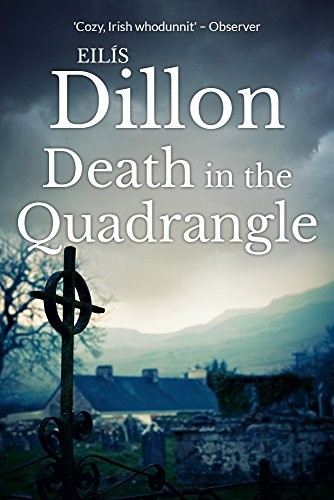
Friday’s Forgotten Book: Death in the Quadrangle by Eilis Dillon

Eilis Dillon (1920-1994) was a productive Irish author whose primary target audience was the young adult reader. She wrote 38 YA books as well as two plays, an autobiographical history, eight novels, and three mysteries, two featuring retired Professor Daly, formerly of King’s University in Dublin and now of Galway, and Inspector Mike Kenny of the Civic Guards. A prize in her name is given annually as part of the Children’s Books Ireland (CBI) Book of the Year Awards.

Death in the Quadrangle (Faber, 1956) is the second collaboration between Professor Daly and Inspector Kenny. Professor Daly has been invited back to King’s University, where he taught for 30 years, to deliver a series of lectures. He arrives to find the academic and support staff in a permanent furor over the behavior of the college president. During his first meeting with President Bradley, Daly learns that Bradley has been receiving threatening letters and wants Daly to use his established contacts within the college to learn who is sending them. He declines, however, to let Daly see them or to call in the police. He is most anxious that nothing interfere with the very large donation that an Irish-American industrialist plans to give to the university, so negative publicity is verboten and inviting a police investigation is out of the question.

The morning after a miserable dinner party during which most of the senior academics displayed their enmity toward Bradley and paraded their own personal peculiarities, Bradley is found dead in his bed. There is no way the death can be considered natural or accidental, and Inspector Kenny is neck-deep in a murder investigation with any number of potential suspects.

It is really too bad that Ms. Dillon decided to focus her literary talents elsewhere, as her plotting is classic Golden Age in style. Her take-down of academic politics and the eccentricities of individual professors is delivered in savagely witty terms. An entertaining read for lovers of academic mysteries and Golden Age detective stories.

Cover photo is from the Kindle edition.

Friday’s Forgotten Book: Body Scissors by Jerome Doolittle

Body Scissors by Jerome Doolittle (Pocket Books, 1990) is the first of six political thrillers released between 1990 and 1995 featuring Tom Bethany, a former member of the Olympic wrestling team and a Vietnam vet, who describes himself as a security consultant but operates more often as a private investigator. Bethany has a profound distrust of the Government and lives as much off the grid as anyone can do in the heart of Boston. His telephone is in someone else’s name, his landlord has never heard of Tom Bethany, he operates on a cash and money order basis, and he opens and closes bank accounts regularly in multiple names.

He is retained by a Massachusetts senator running for president to thoroughly check the background of the senator’s choice for Secretary of State. J. Alden Kellicott appears to be an impeccable choice for the job: he’s a Harvard professor with years of public service and he has a socially prominent wife. The only possible flaw is the death of a daughter that is still considered by the police to be an open homicide investigation.

Bethany is curious enough about the unsolved murder to dig a little deeper and soon after his initial inquiries is approached by a stranger with a knife intent on doing permanent damage to Bethany. His wrestling skills kick in and the attacker becomes the victim in short order, giving Bethany another mystery to investigate.

In view of the recent circus of confirmation hearings for multiple nominees to high Government positions, this book will read as if it is fresh off the pages of the Washington Post. Elements of the plot now seem predictable, I don’t remember reacting that way initially. I don’t know whether that’s attributable to my cynical old age or the changes in society in the 30 years since the book was released. The characters still ring authentic and fresh; I particularly like the owner of the Tasty, the hole-in-the-wall diner that Bethany treats as his office. Doolittle’s skepticism about various former political powerhouses is entertaining, and I can see that I need to read the remaining books in the series again.

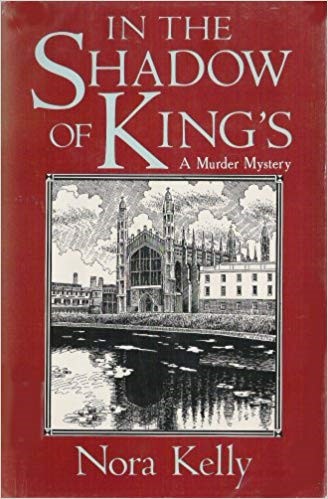
Friday’s Forgotten Book: In the Shadow of King’s by Nora Kelly

In the Shadow of King’s by Nora Kelly (St. Martin’s Press, 1984) is the first of five mysteries featuring Vancouver academic Gillian Adams and her long-distance lover Edward Gisborne of Scotland Yard. In this debut Gillian returns to the University of Cambridge where she received her doctoral degree. She is elated to be back and is in awe of the timelessness of the place. Whole sections of description of the University are strongly reminiscent of Edmund Crispin’s Gervase Fen stories, although they took place at Oxford.

The university has invited her to present her latest scholarly article to the academic community. Alistair Greenwood, Professor of Modern History at Cambridge and a well-known authority, invites her to lunch the day before her presentation. Also invited are the friends Gillian is staying with, an applicant for a teaching position with Greenwood’s department, Greenwood’s cousin, and Greenwood’s brother, who arrives with an atrociously dressed and even worse behaved girlfriend.

Greenwood is notorious for his waspish comments and has each of his guests on edge before the meal is served. He suggests, for instance, that Gillian has chosen a research topic that is too much for her to fully grasp. While nearly everyone who encounters Greenwood despises him, everyone is equally shocked the next day when he is shot during Gillian’s talk at Kings College. Fortunately Edward Gisborne is present to lend moral support to Gillian and promptly takes over.

From there a classic police procedural unfolds. While this book was published far too late to be considered part of the Golden Age, its style and subject were plainly inspired by those classic detective novels. Well worth the time of any reader interested in traditional mysteries.

Friday’s Forgotten Book: The Red Castle Women by Margaret Widdemer

The Red Castle Women (Doubleday, 1968) is the last book written by prolific novelist, children’s author, and poet Margaret Widdemer (1884-1978), who shared the Pulitzer Prize for poetry with Carl Sandburg in 1919. This gothic romance is set along the Hudson River north of New York City about 1840, where a small girl and her unconscious mother were discovered by the river ferryman, who took them both in. The ferryman gave Perdita Van Dorn her name and raised her as his adopted daughter near the Red Castle, a huge mansion where the Somerwell family lived. The Somerwells were known for their wealth and family misfortunes. The parents of the current residents, two cousins named Eugenia and Isobel, were killed when their yacht capsized in a sudden storm years ago. Eugenia and Isobel were raised by a distant cousin, who remains with them as one of their few living relatives.

The present Miss Somerwells are also known for their raging bad tempers. In a dramatic fit of anger Eugenia breaks her engagement to her cousin Mark, accusing him of an improper relationship with Perdita. Because of Eugenia’s threats against Perdita, Mark promptly offers to marry Perdita and she accepts, going from nameless foundling to a member of a wealthy and socially prominent New York family in a matter of minutes. This is the basis of a convoluted but briskly executed plot with kidnapping, human trafficking, attempted murder, bigamy, and criminal insanity. In addition, plot threads with the Underground Railroad, a family curse from an Oneida maiden, and a ghost or two ensure this story has a little something for everyone in less than 300 pages.

I read this book in high school and I was enthralled, both with the romance and the mystery. Apparently I looked for crime in my books even then. This one is undoubtedly a love story but has more violence and felonious activity than I remember in other gothic romances of the time. Re-reading it after so many years also gives me a completely different view of events and motives of the characters. For instance, when Mark offers to marry Perdita to protect her reputation, I originally thought it every woman’s dream come true. Who doesn’t want a Prince Charming to marry her in a whirlwind and then swoop her off to Tiffany’s to buy her diamonds? Now my more cynical reaction is that Mark jumped at the chance to avoid marrying an irascible virago and instead quickly married a more malleable girl barely out of her teens before the virago could change her mind. But that’s just me.

This story is a fine gothic romance, and it can easily pass for a cozy historical mystery that’s a little heavier on the love story than usual. A nice change from present-day thrillers and psychological suspense crime fiction.


Friday’s Forgotten Book: Foggy, Foggy Death by Richard and Frances Lockridge

Foggy, Foggy Death by Richard and Frances Lockridge (J. B. Lippincott, 1950) is the fourth book in the Inspector Heimrich police procedural series, which consists of 24 books released between 1947 and 1977. Heimrich is part of the New York State Police Criminal Investigation Division, and his bailiwick is Westchester County and its surroundings.

In this early entry some of the themes common to the series are evident. The Lockridges wrote about the friction between newcomers to the heretofore exclusive small towns and wealthy country enclaves outside New York City. The sweeping societal changes wrought by the nation’s participation in World War Two created opportunities for the middle class to buy property in areas previously inaccessible to them. The inevitable clashes of values and priorities, at least in the Lockridge books, often lead to murder.

In this particular title, instead of buying the house next door, the encroaching member of the middle class married into an established Westchester family, much to the dismay of the family matriarch. Scott Bromwell met Marta, a Nebraska native, while he was serving in the Army and married her on impulse. The entire family regrets his decision, as Marta has not adapted to the lifestyle or expectations of Scott’s imperious mother. The family is housebound in late January by a dense cold fog that has lasted for days and the unavoidable confinement exacerbates underlying tensions. Marta goes for a walk to escape and is found hours later facedown in a stream on the property.

This is a classic country house mystery with a limited set of suspects due to the weather conditions. Nearly all of the action takes place on the Bromwell estate and most of it within the house. While the homicide forensics team assesses the area around the stream as well as searches the house, Inspector Heimrich and Sgt. Forniss devote most of their time to interviewing the family, the staff, and some incidental visitors who turn out to have a greater involvement with the family than originally supposed. Because of this strict observance of the country house set-up, there is little action and a great deal of talk.

The books in this series seem generally timeless, probably because of the lack of references to technology or other elements that would place the book firmly in a chronological frame. It is one of the reasons this Lockridge series, rather than the Mr. and Mrs. North books, remains among my favorites.